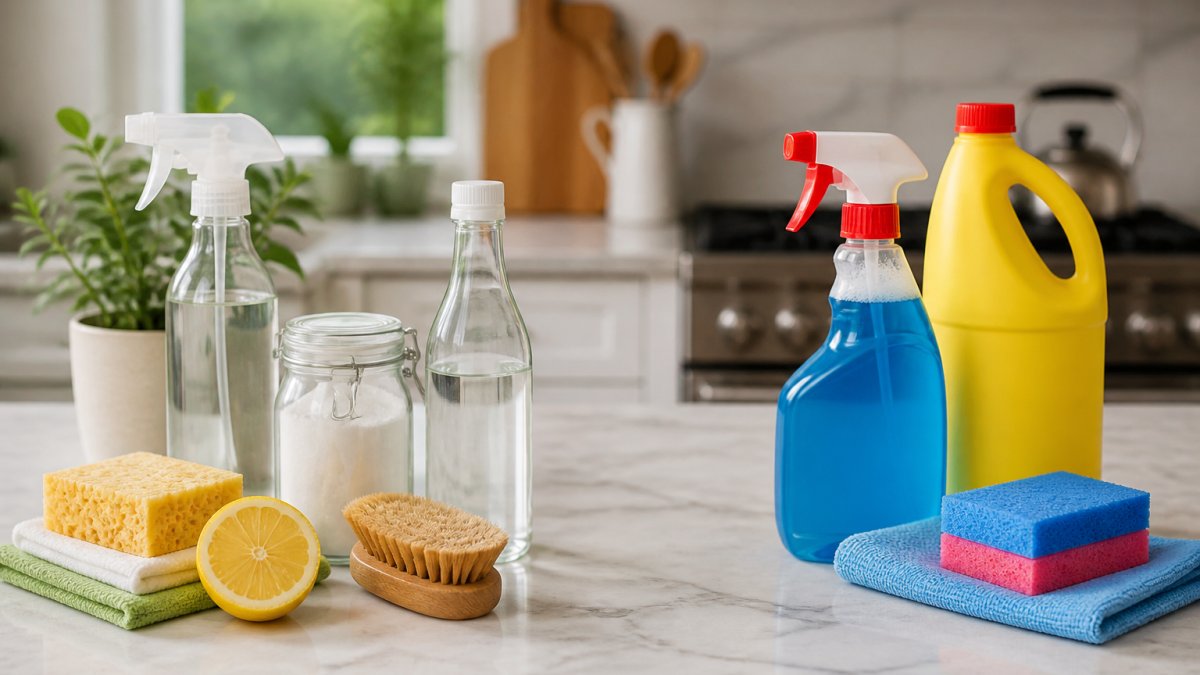
Green vs Traditional Cleaning: What Works Best
Table of Contents
- Green Cleaning vs Traditional Cleaning: The Core Differences
- Health and Safety: Indoor Air Quality and Chemical Exposure
- Green Cleaning Methods That Actually Work
- Understanding Green Cleaning Cost vs Traditional Pricing
- EPA Safer Choice Cleaning Products and Certifications
- Common Green Cleaning Mistakes to Avoid
- Cleaning Effectiveness: Does Green Really Work?
- Making the Right Choice for Your Home
- Frequently Asked Questions
Last Updated: October 5, 2026
Green Cleaning vs Traditional Cleaning: The Core Differences
When you compare green cleaning vs traditional cleaning methods, you're really asking: what's the trade-off between safety and power?
Traditional cleaning relies on chemical disinfectants and detergents designed to cut through tough soil, kill microbes fast, and leave surfaces gleaming. Green cleaning uses plant-based or biodegradable ingredients that prioritize lower toxicity and environmental impact (the EPA).
The core distinction: traditional methods optimize for cleaning effectiveness and speed, while green methods optimize for human health and environmental footprint.
Health and Safety: Indoor Air Quality and Chemical Exposure
Indoor air quality suffers when volatile organic compounds (VOCs) from traditional cleaning products linger in your home. These chemicals evaporate into the air and can trigger respiratory irritation, especially in children and pets (the EPA).

That said, "green" doesn't automatically mean safe, some plant-based cleaners still irritate sensitive airways.
Common concerns with traditional cleaning products:
- Chemical residue on surfaces that young children touch
- Strong fumes that linger for hours after cleaning
- Allergic reactions in people with sensitivities
- Accumulation of toxic compounds in poorly ventilated spaces
Green cleaning reduces allergens and respiratory irritants, but it doesn't eliminate the need for ventilation.
Green Cleaning Methods That Actually Work
Green cleaning methods rely on mechanical action, dilution, and time rather than raw chemical strength.
Here's where green cleaning excels:
- Daily and weekly maintenance cleaning
- Dust and light soil removal
- General surface sanitizing in low-risk environments
- Homes with children, pets, or chemical sensitivities
Here's where it struggles:
- Heavy grease buildup in kitchens
- Mold and mildew in damp bathrooms
- Disinfection in healthcare or high-touch settings
- Stubborn stains on porous surfaces
Green cleaning works best when you stay ahead of the mess. Weekly maintenance keeps surfaces clean; months of buildup may need traditional methods to catch up, then green for ongoing care.
We customize our approach to your needs. For Airbnb turnovers, we combine both methods, green cleaning for routine touch-ups and traditional disinfection for high-touch surfaces between guests, keeping properties spotless without unnecessary chemical exposure.
Understanding Green Cleaning Cost vs Traditional Pricing
Upfront price per bottle is the least useful number here. The real question is total cost of ownership: what you pay per cleaning task once you account for dilution, labor, equipment, packaging, waste, and downstream costs of chemical exposure.
Why the sticker price misleads
Concentrated cleaners cost more per container but less per use. A ready-to-use spray is mostly water, so you're paying to ship and store water; a concentrate diluted at the label ratio yields many more bottles. Savings only materialize with correct dilution, over-diluting wastes product, under-diluting wastes money and can damage surfaces.
A practical way to compare is cost per cleaning task, not cost per ounce:
- Cost per diluted quart or gallon, divide the container price by the number of diluted units the label yields.
- Cost per square foot cleaned, useful for floors and large surfaces.
- Cost per high-touch point, useful for disinfection, where contact time and product volume matter.
The cost factors that actually matter
| Cost factor | Green cleaning | Traditional cleaning |
|---|---|---|
| Product price per container | Usually higher | Usually lower |
| Dilution yield | Often high (concentrates) | Mixed; many are ready-to-use |
| Labor per task | Can be higher if technique is poor | Often lower for heavy soil |
| Equipment | Microfiber, color-coded cloths, spray bottles | Mops, buckets, disposable wipes |
| Packaging and waste | Refill and concentrate formats reduce plastic | Single-use wipes and bottles add waste |
| Ventilation and downtime | Lower fumes, less airing-out time | More ventilation needed after use |
| Surface damage risk | Generally lower on delicate finishes | Higher with harsh or abrasive products |
| Health-related costs | Potentially lower over time | Potentially higher over time |
Labor is usually the largest line item
For professional cleaning, labor typically dominates the cost stack. Green methods reduce labor when maintenance is consistent, since surfaces stay cleaner between visits, but increase labor in neglected spaces where mechanical action and dwell time replace chemical strength. The cheapest program isn't the one with the lowest product cost, it's the one that keeps soil from accumulating.
Packaging, waste, and refill economics
Concentrates and refill systems reduce packaging waste and shipping weight, lowering cost per use over time. Single-use disinfecting wipes are convenient but carry the highest cost per task and the most waste. For cost per task, refillable concentrates and reusable microfiber usually win; for speed on high-touch disinfection, registered wipes may be worth the premium.
Health and remediation costs are real but hard to quantify
Reduced chemical exposure can mean fewer respiratory complaints, less airing-out time, and lower residue risk on items children and pets touch. These benefits are genuine but hard to price. Treat them as risk reduction, not guaranteed savings, and be skeptical of any comparison promising a specific payback period without data.
How to build a fair comparison for your space
- List every task: floors, glass, restrooms, kitchens, high-touch disinfection.
- For each task, note the product, dilution ratio, and dwell time required.
- Estimate product volume per task and multiply by cost per diluted unit.
- Add labor minutes per task at your loaded hourly rate.
- Add equipment replacement and packaging waste.
- Compare the totals, not the shelf prices.
Done this way, green and traditional programs often land closer than the sticker price suggests, and the winner depends on your soil load, cleaning frequency, and whether you need registered disinfection.
EPA Safer Choice Cleaning Products and Certifications
Certifications are a shortcut, not a guarantee. They confirm a product met defined criteria, but they don't tell you it will disinfect or cover every label claim. Reading certifications and ingredient disclosures is the fastest way to separate credible green products from marketing language.
What the major certifications actually cover
- EPA Safer Choice, A U.S. Environmental Protection Agency program that reviews ingredient chemistry for human health and environmental safety. It is one of the few labels backed by government review rather than self-declaration. It does not certify disinfection performance.
- Green Seal, An independent third-party standard covering environmental and health criteria across product categories, including cleaning products and services.
- UL ECOLOGO, A third-party certification for reduced environmental impact across a product's life cycle.
- Cradle to Cradle, Focuses on material health, recyclability, and lifecycle design rather than cleaning performance.
- Design for the Environment (DfE), An EPA recognition for safer chemical ingredients in specific product categories.
None of these labels certify that a product kills germs. That is a separate regulatory pathway.
Disinfection is a different claim entirely
In the United States, products claiming to kill or reduce specific microorganisms on surfaces are regulated as antimicrobial pesticides and must be registered with the EPA, meaning the manufacturer submitted efficacy data for specific organisms and contact times (the EPA). A product can be certified green and still not be a registered disinfectant, and vice versa.
How to spot greenwashing
Greenwashing is any environmental-sounding claim that isn't verifiable. Common patterns:
- Vague terms, "natural," "eco-friendly," "non-toxic," and "chemical-free" have no standardized legal definition for cleaning products. Water is a chemical, so "chemical-free" is meaningless.
- Hidden ingredients, "Proprietary blend" and "natural fragrance" can conceal irritants. Fragrance mixtures are a common trigger for sensitivities even when labeled natural.
- Single-attribute claims, "Biodegradable bottle" says nothing about the contents. "Plant-based" says nothing about toxicity.
- Misleading imagery, Green leaves, earth tones, and the word "pure" are design choices, not certifications.
- Self-created seals, A logo that looks like a certification but is issued by the manufacturer is not third-party verified.
What to look for instead
- A recognized third-party certification or an EPA registration number, depending on the claim.
- A full ingredient list, ideally with fragrance components disclosed.
- A dilution ratio and contact time printed on the label.
- Safety data sheets available on request, which list hazards and first-aid measures.
- A signal word (Caution, Warning, Danger) that matches the actual hazard, not a marketing tone.
The practical takeaway
Certifications reduce guesswork but do not replace reading the label. Use them to narrow the field, then verify the specific claim you need: safer chemistry for routine cleaning, or registered efficacy for disinfection. When a product cannot tell you what is in it or what it is registered to do, treat the green claim as unproven.
Common Green Cleaning Mistakes to Avoid
Mistake 1: Using the wrong dilution ratio. Concentrated green cleaners need proper dilution.
Mistake 2: Skipping contact time. Green cleaners often need 30 seconds to 2 minutes to break down soil.
Mistake 3: Not pre-treating tough spots. Grease stains and dried-on food need soaking time.
Mistake 4: Using the same method for everything. A green all-purpose cleaner works for counters and glass.
Mistake 5: Assuming "green" means "safe to mix." Some green products still create toxic fumes when combined.
Mistake 6: Giving up after one try. Green cleaning is a habit. Your first attempt might disappoint.
Cleaning Effectiveness: Does Green Really Work?
The straight answer: green cleaning works as well as traditional cleaning for routine maintenance. For heavy soil and disinfection, traditional methods still have the edge.
Soil removal depends on mechanical action and time, not just chemistry.
Disinfection is where the gap widens. Traditional disinfectants kill specific microbes in specific contact times, usually 10 seconds to 10 minutes. Green disinfectants claim effectiveness but often lack the same validation.
The real test: do surfaces stay clean? Green-cleaned homes stay cleaner longer with consistent maintenance; traditionally cleaned homes can go longer between deep cleans.
Making the Right Choice for Your Home
Your decision between green cleaning vs traditional cleaning methods comes down to three questions:
Question 1: Who lives in your home? Children, pets, and people with respiratory sensitivities benefit from lower chemical exposure. Healthy adults in good ventilation can tolerate traditional products without issue.
Question 2: What's your cleaning schedule? Green cleaning thrives on consistency. Weekly maintenance with green methods keeps homes spotless.
Question 3: What surfaces need cleaning? Routine dust and light soil? Green works. Baked-on grease, mold, or high-touch disinfection? Traditional methods deliver faster results.
The best approach often combines both. Use green methods for daily and weekly maintenance.
Your home deserves a cleaning approach that matches your values and needs.
Finding the right cleaning method takes trial and error, and many homeowners waste time testing products that don't fit their homes.
Frequently Asked Questions
What is the difference between green cleaning and traditional cleaning?
Green cleaning uses plant-based, biodegradable products and methods designed to minimize chemical exposure and environmental impact. Traditional cleaning relies on chemical disinfectants and detergents that may contain volatile organic compounds (VOCs) and harsh ingredients. Green methods often employ microfiber cloths, vinegar, baking soda, and certified products, while traditional approaches prioritize strong chemical disinfection for rapid results. Both can achieve clean surfaces, but they differ in ingredients, environmental footprint, and health considerations.
Is green cleaning more expensive than traditional cleaning?
Green cleaning cost depends on your approach. Homemade green solutions using vinegar and baking soda cost less than traditional chemical products. However, EPA Safer Choice certified products and professional green cleaning services may have higher upfront costs. Long-term savings often emerge through concentrated products requiring less dilution and reduced health-related expenses. For professional services, pricing varies by provider and service scope, contact Chelsea Cleaning Company for a personalized quote.
Are green cleaning products safer around children and pets?
Yes, green cleaning products are generally safer for children and pets because they contain fewer toxic ingredients and lower VOC levels. Traditional chemical disinfectants can cause respiratory irritation, allergic reactions, and chemical exposure risks, especially in homes with young children or pets. Green cleaning methods reduce allergens and indoor air quality concerns while still removing dirt, grime, and microbes. Always verify ingredient disclosure on any product and follow dilution instructions, whether green or traditional.
Can green cleaning methods disinfect and sanitize effectively?
Green cleaning methods can sanitize through contact time and proper technique, though disinfection requirements vary by situation. For routine cleaning and sanitizing, green products with certified ingredients work well. However, healthcare settings or high-contamination scenarios may require stronger chemical disinfectants for sterilization. Most homes benefit from green sanitizing methods for daily maintenance. Professional cleaners can customize protocols based on your specific disinfection needs and use cases.
