
Managing Airbnb Turnover During Peak Season
Quick Summary
Managing airbnb turnover during peak season comes down to three things: a checklist that works when you are rushed, a timeline with firm deadlines, and a clear plan for who does what when the calendar is full. Start by naming which failure point hits your property hardest, since that tells you which fix to build first.
- Keep the checklist short enough to finish under time pressure, with the most important items first.
- Work backward from check-in time to set a firm deadline, such as having the unit locked and ready 30 minutes early.
- Budget about 60% of same-day turnover time for cleaning, since most hosts underestimate the rest.
- Forecast staffing from the booking calendar and plan to about 80% of cleaner capacity, holding the rest as buffer.
- Set a call-in deadline and name a backup cleaner before peak season starts, not on the morning of a turnover.
Table of Contents
- Why Airbnb Turnover Breaks Down During Peak Season
- Building an Airbnb Turnover Checklist That Holds Up Under Pressure
- Mapping a Peak-Season Turnover Timeline With Same-Day Check-In Deadlines
- Planning Cleaner Staffing, Backup Coverage, and Workload Limits
- Handling Back-to-Back Airbnb Bookings Without Sacrificing Quality
- Quality Control, Escalation, and Restocking Between Guests
- When to Hand Turnovers to a Professional Airbnb Cleaning Service
- Booking Your Next Peak-Season Turnover Schedule With Chelsea Cleaning Company
- Frequently Asked Questions
Airbnb turnover during peak season is where a good schedule quietly falls apart. Bookings stack up back-to-back, check-out and check-in times collide, and one late cleaner can push a guest's arrival into chaos.
Managing airbnb turnover during peak season comes down to three things: a checklist that works when you are rushed, a timeline with firm deadlines, and a clear plan for who does what when the calendar is full.
Why Airbnb Turnover Breaks Down During Peak Season
Turnover problems in peak season usually start with time pressure, not carelessness. A unit that normally has a comfortable gap between guests suddenly has none, and nobody has written down what must happen in that window.
Most breakdowns come from a few predictable causes:
- Compressed gaps: Check-out at 11 a.m. and check-in at 3 p.m. leaves very little room for error.
- No written standard: Each cleaner works from memory, so quality varies from visit to visit.
- Missing supplies: Towels, soap, or coffee run out because nobody tracked stock between guests.
Naming the failure point is the first step. Once you know which of these hits your property hardest, you know which fix to build first.
Building an Airbnb Turnover Checklist That Holds Up Under Pressure
A strong Airbnb turnover checklist is short enough to finish under time pressure and detailed enough that nothing important gets skipped.
Start with these core groups:
- Strip and reset: Remove all used linens, trash, and dishes. Make the beds with fresh sets.
- Kitchen: Clear the sink, wipe counters and appliance fronts, check the fridge for leftovers, and restock coffee, salt, and oil.
- Bathroom: Clean the toilet, shower, and sink. Replace towels, toilet paper, and soap.
- Living areas: Dust surfaces, vacuum or mop floors, and reset cushions and remotes.
- Final walkthrough: Look at each room from the guest's entry point. Check lights, locks, and the thermostat.
Make the checklist visible, printed, laminated, or in a shared digital note cleaners can open on their phones.
Watch out: A checklist that is only ever followed on paper will drift. Review it every few months and remove any item nobody actually checks.
Mapping a Peak-Season Turnover Timeline With Same-Day Check-In Deadlines
When a guest checks out and a new guest checks in on the same day, the timeline is your single most important tool, more important than the checklist, because the checklist assumes there is enough time and the timeline proves whether there is.
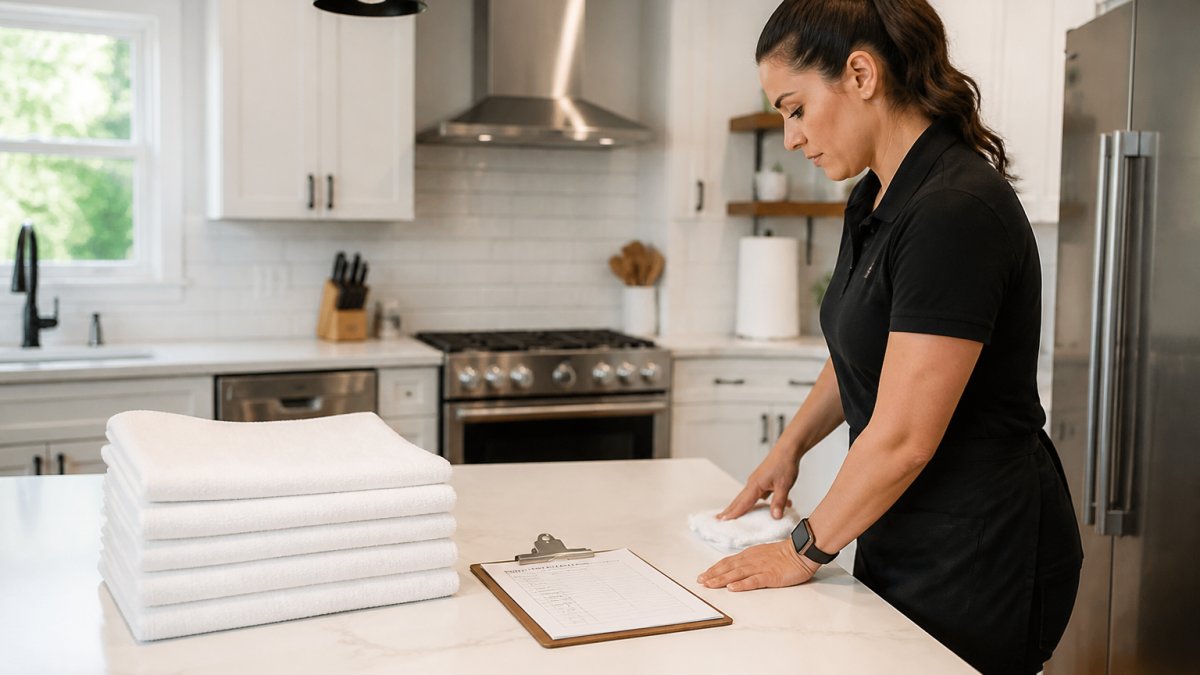
Most hosts underestimate how much of a same-day turnover is not cleaning. To decide when a standard turnover is enough and when a full clean is needed, read whether deep cleaning is necessary between every guest.
An Hour-by-Hour Same-Day Turnover Workflow
Use this as a template and adjust the durations to your unit size and laundry setup. The times assume an 11:00 a.m. checkout and a 3:00 p.m. check-in.
- 10:45 a.m., Pre-arrival staging: Cleaner confirms access, stages the turnover kit (fresh linens, toiletries, consumables, cleaning caddy) at the door, and texts the outgoing guest a friendly checkout reminder if needed.
- 11:00 a.m., Checkout and unit walk: Guest departs. Cleaner enters within 15 minutes, opens windows, and does a 3-minute damage and lost-and-found scan before stripping anything. Photograph anything broken, stained, or missing immediately, before cleaning hides the evidence.
- 11:15 a.m. to 12:15 p.m., Strip, trash, and dishes: Remove all linens and towels to laundry bags, bag all trash, load the dishwasher and start it, and clear the fridge of perishables. This is the dirtiest hour and the one most likely to reveal a problem (a clogged drain, a broken blind, a stain that will not lift).
Same-Day Check-In Deadline Math
The 11:00 a.m. to 3:00 p.m. window is four hours, but the usable turnover window is closer to three once you subtract entry, staging, and lock-up. That is why a 3:00 p.m. check-in with an 11:00 a.m. checkout is the practical floor for a single cleaner on a one-bedroom unit. For a two-bedroom or a unit with in-unit laundry, the same window requires a two-person team or a 10:00 a.m. checkout, hosts who book same-day turns on larger units without adjusting either are the ones with cleanliness complaints in reviews.
Contingency Branches for the Three Most Common Failures
A timeline without contingency branches is a wish. Build these three into the plan:
- Late checkout: If the guest has not departed by 11:15 a.m., the cleaner starts exterior and laundry staging tasks that do not require entry, and the host messages a firm but friendly departure reminder. If the unit is still occupied at 11:45 a.m., the turnover is at risk, offer the incoming guest a delayed check-in or a small credit rather than rush the clean.
- Failed inspection: If the inspection photo set reveals a stain, damage, or missing item that cannot be resolved in 15 minutes, escalate immediately using the severity levels in the quality control section. Do not let the cleaner absorb the problem silently.
- Cleaner no-show or running late: Trigger the backup coverage call at the agreed call-in deadline (see the staffing section). The timeline should include a named backup and a phone number, not a hope.
Sharing the Timeline With Everyone Who Touches the Unit
The timeline only works if the cleaner, the backup cleaner, the laundry runner (if you use one), and whoever manages keys all see the same version. Confirm the next day's schedule the evening before and again the morning of, with a single message listing the unit, checkout time, check-in time, and assigned cleaner.
The hour-by-hour workflow below shows how a same-day turnover breaks down from a 11:00 a.m. checkout to a 3:00 p.m. check-in.
| Time | Task | Duration |
|---|---|---|
| 10:45 a.m. | Pre-arrival staging | Before checkout |
| 11:00 a.m. | Checkout and unit walk | Enter within 15 minutes |
| 11:15 a.m. to 12:15 p.m. | Strip, trash, and dishes | 1 hour |
| 12:15 to 1:15 p.m. | Clean and reset | 1 hour |
| 1:15 to 1:45 p.m. | Restock and inspect | 30 minutes |
| 1:45 to 2:15 p.m. | Laundry and final walkthrough | 30 minutes |
| 2:15 to 2:30 p.m. | Buffer and confirmation | 15 minutes |
| 2:30 p.m. | Locked and ready | Before check-in |
Planning Cleaner Staffing, Backup Coverage, and Workload Limits
Peak season does not just add turnovers, it compresses them into the same few windows. A cleaner who comfortably handles two units on a normal Tuesday may be asked to handle four on a peak Saturday, and the quality difference between turnover two and turnover four is where reviews are won and lost. Staffing for peak season is a capacity-planning problem: know how many turnover hours your calendar demands before you know how many cleaners to line up.
Forecast Turnover Volume From the Calendar, Not From Memory
Pull your booking calendar for the peak window and count same-day turns, not reservations. A same-day turn is any reservation whose check-in date matches another reservation's checkout date on the same unit.
Then apply a standard turnover-hour estimate per unit size. A common planning range is:
- Studio or one-bedroom: 1.5 to 2.0 cleaner-hours
- Two-bedroom: 2.5 to 3.0 cleaner-hours
- Three-bedroom or larger: 3.5 to 5.0 cleaner-hours, depending on bathrooms and laundry
Multiply turns by hours to get total cleaner-hours per day. If a peak Saturday shows 14 same-day turns and your average unit is a two-bedroom at 2.75 hours, that Saturday demands roughly 38.5 cleaner-hours.
Set Workload Limits That Protect Quality
A cleaner who handles four units in a single day will not deliver the same quality as one who handles two, and the fourth turnover is usually the one that gets rushed. Set a maximum number of turnovers and cleaner-hours per cleaner per day, and stick to both. A practical ceiling for most independent cleaners is three same-day turns or six cleaner-hours, whichever comes first. Larger teams or teams with a dedicated laundry runner can push higher, but only if the timeline in the previous section is genuinely achievable at that volume.
Workload limits are also a retention tool. Peak season is when good cleaners quit because they are overloaded and under-supported. Publishing the limit in advance, "you will not be assigned more than three same-day turns in a day", is one of the cheapest retention moves available.
Recruit Backup Cleaners Before the Season Starts
Backup coverage is not something you can improvise on a peak Saturday morning. Recruit in the shoulder season, and recruit more than one. A workable backup bench has three layers:
- A named primary backup who has cleaned your units before, holds a copy of the checklist, and knows the access instructions. This person should be scheduled at least once in the shoulder season so the knowledge stays fresh.
- A secondary backup, often a cleaner from a neighboring route or a small local cleaning company, who can be called if the primary is already committed.
- A last-resort plan for the rare day both backups are unavailable: a shortened "arrival-ready" clean that covers beds, bathroom, kitchen surfaces, and trash, with a note to the host that a full clean will follow. Guests forgive a missing decorative throw; they do not forgive a dirty bathroom.
Give every backup the same onboarding packet: the checklist, the timeline template, access codes, Wi-Fi and thermostat instructions, escalation contacts, and the photo documentation standard. A backup who has to be trained on the day is not a backup.
A Backup Coverage Protocol With a Call-In Deadline
Agree on a call-in deadline, typically 7:00 a.m. on the day of the turnover, by which a cleaner must report an absence or delay. That gives the host or coordinator time to activate the backup before the first checkout. The protocol should be written and shared with every cleaner and backup:
- By 7:00 a.m.: Cleaner confirms availability for the day's assigned turns.
- 7:00 to 7:30 a.m.: If a cleaner has not confirmed or has reported an issue, the coordinator calls the primary backup.
- 7:30 to 8:00 a.m.: If the primary backup is unavailable, the coordinator calls the secondary backup and, if needed, reallocates turns among the remaining cleaners within their workload limits.
This protocol sounds heavy, but it takes about 15 minutes a day and is the difference between a managed peak Saturday and a cascade of late check-ins.
Schedule the Week Before the Week Starts
Do not assign peak-week cleaners on Monday morning for Monday turnovers. Assign the full week, ideally the full peak month, in advance, with the backup named on every high-risk day (Saturdays, holiday weekends, and any day with three or more same-day turns). Publish the schedule where cleaners can see it, and confirm each cleaner's acceptance in writing. A schedule that lives only in the host's head is not a schedule; it is a hope.
Handling Back-to-Back Airbnb Bookings Without Sacrificing Quality
Back-to-back bookings are the hardest part of peak season. The gap between guests can shrink to a few hours, so every minute counts. The goal is to protect quality without making the schedule impossible.
A few approaches help:
- Adjust booking rules: Some hosts set a minimum gap of several hours between stays on peak weekends. This is a tradeoff: fewer bookings, but a better guest experience and fewer rushed turnovers.
- Use a deep clean rotation: Schedule a full deep clean on quieter days, so peak-day turnovers stay focused on the essentials.
- Keep consumables stocked: Pre-stock a turnover kit with the items cleaners use most, so nothing has to be fetched mid-turnover.
Quality Control, Escalation, and Restocking Between Guests
Quality control does not need to be complicated. After each turnover, do a quick photo check of key areas: beds, kitchen, and bathroom.
Set a clear escalation path. For practical guidance on handling guest complaints about cleanliness, including escalation steps, see the dedicated article.
Restocking should follow a par level system. Decide the minimum number of each item that must be on hand at all times, such as six bath towels per guest.
When to Hand Turnovers to a Professional Airbnb Cleaning Service
Some hosts can manage peak-season turnovers on their own. Others reach a point where the workload, travel between units, or the need for consistent quality makes outside help the better choice.
Ask any provider how they handle same-day turnovers, what their backup plan is, and how they report problems. For a closer look at how a professional Airbnb turnover guide frames scope, checklists, and cost factors, see professional Airbnb turnover best practices.
Chelsea Cleaning Company offers customized Airbnb turnover checklists tailored to each property, along with a 24-hour satisfaction guarantee on every visit.
Booking Your Next Peak-Season Turnover Schedule With Chelsea Cleaning Company
Peak season arrives faster than most hosts expect, so planning now makes a real difference. Review your booking calendar, mark the back-to-back weekends, and decide which of the steps above you can put in place this month.
If you want help with cleaning for your units, contact Chelsea Cleaning Company.
Frequently Asked Questions
What should I include in my Airbnb turnover checklist?
A useful Airbnb turnover checklist follows the order cleaners actually work in. Start with a walkthrough for damage and missing items, then strip and remake beds, clean bathrooms, dust and wipe high-touch surfaces, clean the kitchen including the fridge and oven, vacuum or mop floors, and restock consumables like toilet paper, coffee, and trash bags. End with a final photo check of each room. Customize the list for your property, and note any items that frequently get missed, such as baseboards, cabinet interiors, or light switches, so they are checked every time.
How long should an Airbnb turnover take?
Track how long each turnover actually takes for a few weeks during peak season, then build your same-day check-in schedule around that real number.
How can I manage back-to-back Airbnb bookings during peak season?
Manage back-to-back bookings by setting a firm turnover window between checkout and check-in, then scheduling the cleaner for that window in advance. Use a minimum-night rule or a same-day gap buffer where possible, and confirm cleaner availability before accepting a booking that leaves less than about three hours between guests. Keep a backup cleaner on call so a no-show does not push the next arrival back.
Should I hire a professional cleaning service for Airbnb turnovers?
A professional cleaning service makes sense when you manage several units, when bookings stack up during peak weeks, or when your own schedule cannot cover every turnover. Ask any provider for a written checklist and a way to report problems the same day. Chelsea Cleaning Company offers customized Airbnb turnover checklists and a 24-hour satisfaction guarantee. For current pricing, visit the Chelsea Cleaning Company website or request a quote.

